

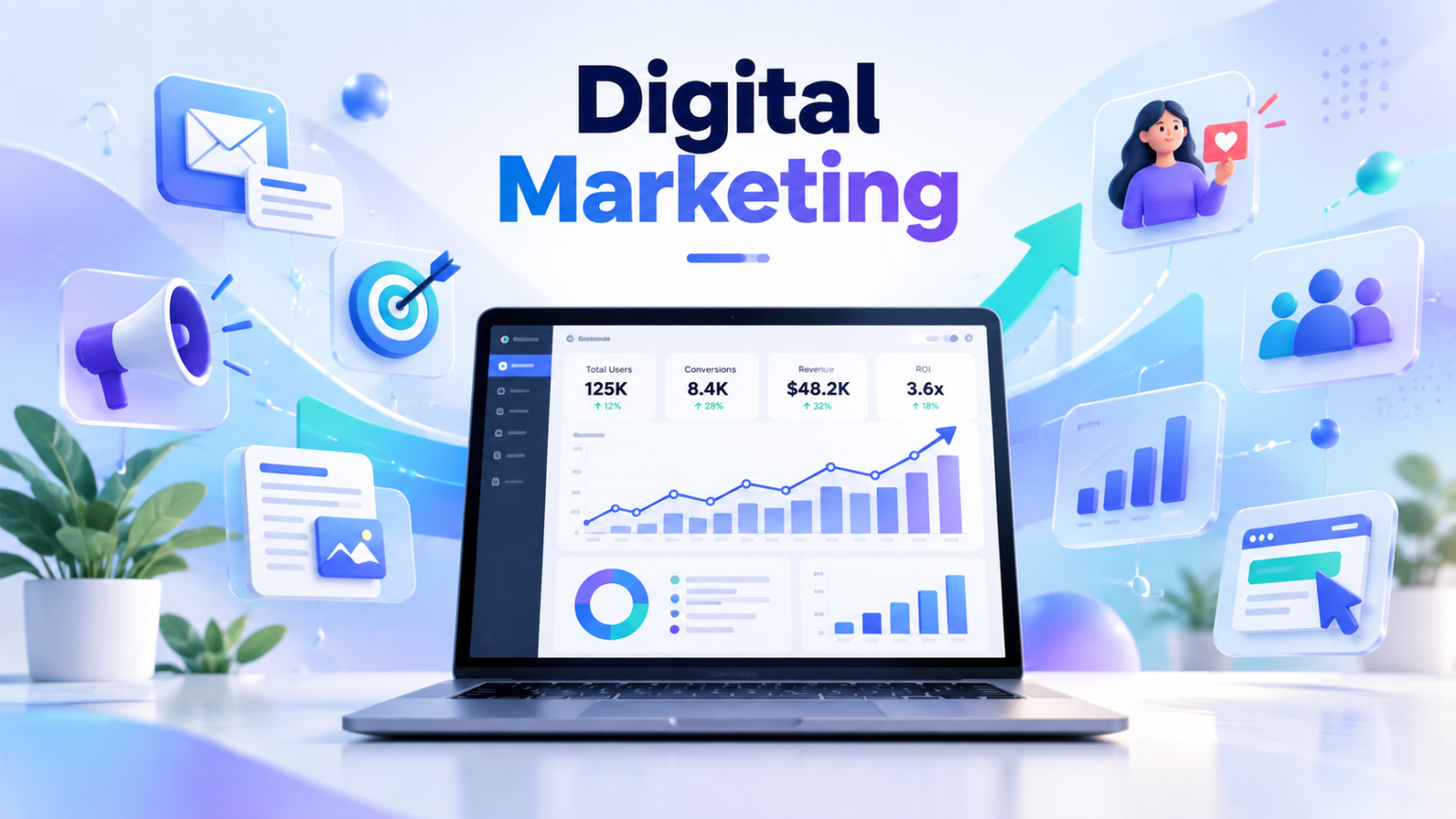
Digital marketing is the process of promoting a business, product, service, or brand through online channels. It includes search engines, websites, social media platforms, email, online advertising, content marketing, video marketing, and several other digital touchpoints.
For modern businesses, digital marketing is no longer simply an alternative to traditional marketing. It has become one of the primary ways customers discover businesses, research products, compare alternatives, communicate with brands, and make purchasing decisions.
A successful digital marketing strategy connects all these channels instead of treating them as separate activities.
What Is Digital Marketing?
Digital marketing refers to marketing activities performed through digital platforms and technologies.
Businesses use digital marketing to:
- Reach potential customers
- Build brand awareness
- Generate website traffic
- Capture leads
- Increase sales
- Retain existing customers
- Build communities
- Measure marketing performance
Unlike many traditional marketing methods, digital marketing provides detailed performance data.
A business can determine how many people saw an advertisement, clicked it, visited a website, submitted a form, purchased a product, or returned later.
This measurability makes digital marketing highly valuable for businesses seeking scalable growth.
Major Types of Digital Marketing
Digital marketing consists of several disciplines.
Search Engine Optimization
Search Engine Optimization, or SEO, improves a website's visibility in organic search results.
SEO activities include:
- Keyword research
- On-page optimization
- Technical SEO
- Content creation
- Internal linking
- Link building
- Local SEO
- User experience improvement
The objective is to help search engines understand a website while providing useful information to users.
Strong SEO can generate traffic for months or years without businesses paying for every visitor.
Search Engine Marketing
Search Engine Marketing usually includes paid advertising on search engines.
Google Ads is one of the most commonly used platforms.
Businesses can display advertisements when users search for specific keywords.
For example, someone searching for "best digital marketing agency in Delhi" could see sponsored advertisements above organic results.
Search advertising is particularly powerful because it captures users with existing intent.
Social Media Marketing
Social media marketing uses platforms such as:
- YouTube
- X
Brands can publish organic content or use paid advertisements.
Social media marketing helps businesses create communities, distribute content, generate engagement, and reach new audiences.
The most successful brands combine organic social media content with paid amplification.
Content Marketing
Content marketing focuses on creating useful information that attracts and educates potential customers.
Common content formats include:
- Blog articles
- Videos
- Guides
- Reports
- Case studies
- Podcasts
- Infographics
- Webinars
- Newsletters
Content can influence customers throughout their entire purchasing journey.
Educational content helps people understand problems, while product-focused content helps them evaluate solutions.
Email Marketing
Email marketing allows businesses to communicate directly with prospects and customers.
Businesses commonly use email for:
- Welcome campaigns
- Product announcements
- Lead nurturing
- Educational newsletters
- Promotional campaigns
- Abandoned-cart reminders
- Customer retention
Unlike social media platforms, an email list represents an audience that a business can communicate with directly.
Performance Marketing
Performance marketing focuses on measurable business outcomes.
Marketers analyze metrics such as:
- Cost per click
- Cost per lead
- Cost per acquisition
- Conversion rate
- Return on advertising spend
- Customer acquisition cost
The objective is not simply to generate visibility. It is to generate measurable results efficiently.
Affiliate Marketing
Affiliate marketing allows third parties to promote products in exchange for commissions.
Affiliates can include bloggers, influencers, publishers, comparison websites, and content creators.
Businesses pay affiliates when specific actions occur, such as purchases or qualified leads.
Influencer Marketing
Influencer marketing involves partnering with people who already have established audiences.
Influencers can help brands gain awareness and credibility within specific communities.
However, businesses should evaluate influencers based on audience relevance, engagement quality, and business impact rather than follower count alone.
How a Digital Marketing Funnel Works
Most customers do not purchase immediately after discovering a brand.
They move through several stages.
Awareness
The customer discovers the brand.
Channels may include:
- Google Search
- YouTube
- Online advertisements
- Blog content
Consideration
The customer researches the business and compares alternatives.
Useful content includes:
- Product comparisons
- Reviews
- Case studies
- Educational guides
- Testimonials
Conversion
The user takes a commercial action.
Examples include:
- Purchasing
- Booking a consultation
- Submitting a form
- Starting a free trial
Retention
Marketing continues after the sale.
Businesses can use email, loyalty programs, communities, and personalized offers to encourage repeat purchases.
Why Data Matters in Digital Marketing
Digital marketing becomes significantly more effective when decisions are based on data.
Tools such as analytics platforms help marketers understand:
- Website visitors
- Traffic sources
- User behaviour
- Conversion journeys
- Campaign performance
- Revenue contribution
However, collecting data is not enough.
Marketers must translate data into decisions.
For example, if thousands of users visit a landing page but few convert, the business may need to improve the offer, messaging, form, user experience, or page speed.
Organic vs Paid Digital Marketing
Organic marketing includes channels where businesses do not directly pay for each visitor.
Examples include:
- SEO
- Organic social media
- Content marketing
- Email lists
Paid marketing includes advertising platforms where businesses pay to reach audiences.
Examples include:
- Google Ads
- Meta Ads
- LinkedIn Ads
- YouTube Ads
Strong digital strategies usually combine both.
Paid campaigns provide speed, while organic marketing builds long-term assets.
How to Create a Digital Marketing Strategy
A digital marketing strategy should begin with business objectives.
Step one is defining what success means.
Possible objectives include:
- Revenue growth
- Lead generation
- Brand awareness
- Customer acquisition
- App installations
- Online purchases
The next step is identifying the target audience.
Businesses should understand:
- Customer needs
- Search behaviour
- Demographics
- Purchase motivations
- Pain points
- Preferred channels
The company can then choose appropriate marketing channels.
A B2B software company may prioritize SEO, LinkedIn, webinars, and email.
An ecommerce brand may prioritize Google Shopping, Instagram, influencer marketing, and remarketing.
Measuring Digital Marketing Success
Important metrics depend on business objectives.
Common digital marketing KPIs include:
- Organic traffic
- Search rankings
- Leads generated
- Conversion rate
- Cost per lead
- Customer acquisition cost
- Revenue
- Return on ad spend
- Customer lifetime value
- Engagement rate
Businesses should avoid relying excessively on vanity metrics such as impressions or followers without understanding their contribution to business goals.
The Future of Digital Marketing
Digital marketing continues to evolve.
Artificial intelligence is changing content creation, advertising optimization, search behaviour, personalization, and analytics.
Search itself is expanding beyond traditional search engines.
Consumers increasingly discover information through:
- AI assistants
- Social platforms
- Video platforms
- Community websites
- Marketplace search engines
This means businesses must create information that is useful across multiple discovery environments.
The fundamentals, however, remain unchanged.
Businesses must understand customers, provide value, communicate clearly, measure results, and continuously improve.
Digital marketing is not one campaign or one platform.
It is an interconnected growth system.
When SEO, content, advertising, analytics, social media, email, and conversion optimization work together, digital marketing can become one of the most powerful growth engines available to a business.


 I’m Piyush, an AI Search & Growth Marketing professional with 9+ years of experience building search-led acquisition systems, scalable content ecosystems, and performance-driven growth strategies for B2B technology companies.